Key Events
Written by Ilana Jacobs
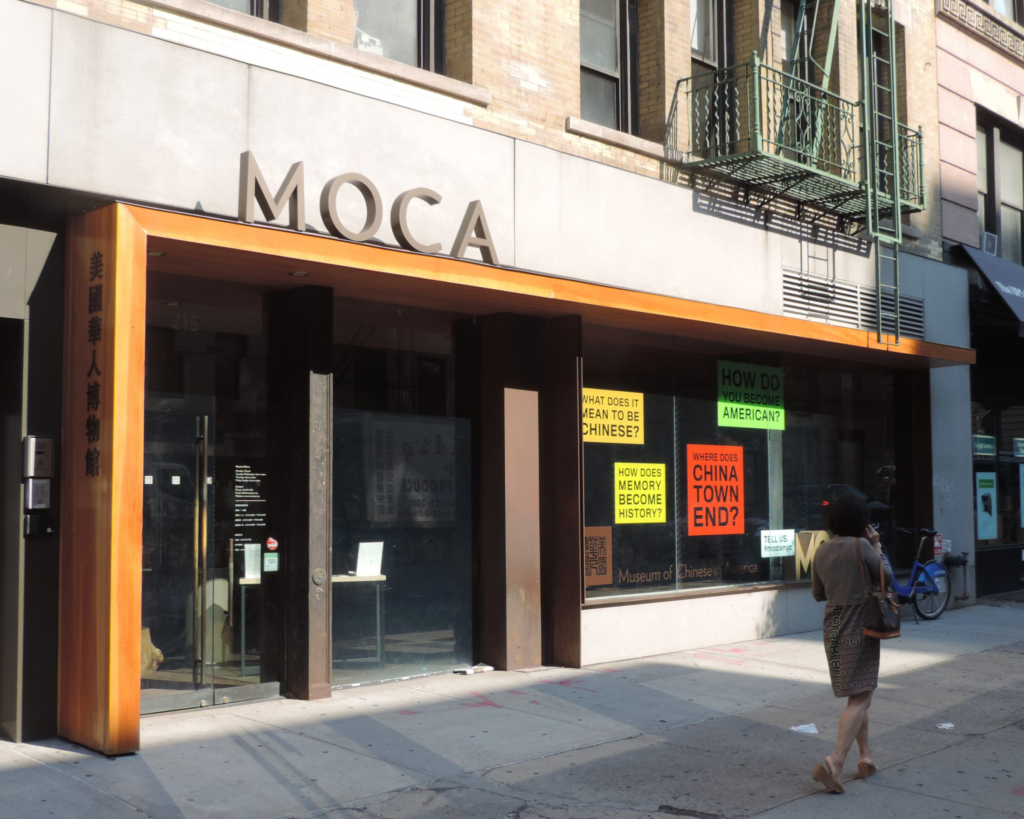
On July 15, 2021, protesters gathered to picket the reopening of the Museum of Chinese in America (MOCA), with signs saying things like “Hey MOCA! Return the $35 million to the community,”1 “Stop racial violence / stop the 24-hour workday,”2 and “Chinatown is not a museum / stop displacing workers.”3
While the protests have been reported on the new on-and-off for a couple months, recently an open letter from two artists withdrawing from an exhibition illuminated the conflict for the public stage. The artists, Colin Chin, and Nicholas Liem, withdrew their pieces from MOCA’s recent exhibition on anti-AAPI violence, Responses: Asian American Voices Resisting the Tides of Racism. Sent on July 11, the letter was directed to the museum’s curator, Herb Tam to alert him to their absence from upcoming events.
Dear MOCA Board and Staff,
We would like to thank you again for selecting our work in your upcoming exhibition, Responses: Asian American Voices Resisting the Tides of Racism. We have long held respect for MOCA’s mission of celebrating and presenting the experience of Chinese people in America. To our great disappointment, we learned of the museum’s acceptance of a $35 million concession from the city to build a new jail in the neighborhood. We also learned of MOCA Board of Director Co-Chair Jonathan Chu’s role in the gentrification of Chinatown, which includes closing the two first and only unionized restaurants in Chinatown, Silver Palace and more recently Jing Fong. Because of this, we have no choice but to withdraw our permission for MOCA’s use of our work in any capacity, including at the upcoming Responses the exhibition and accompanying programs on July 13, 14 and beyond, the One World Collection, and on MOCA’s social media and website. This includes removing any existing posts of or related to our work from MOCA’s site and social media accounts.
We believe MOCA’s complicity with mass incarceration—which disproportionately affects Black and Latinx people—and the gentrification of Chinatown undermines its aforementioned purpose. It is contrary to the expressions of solidarity between the Asian American and Black communities against police violence and gentrification highlighted in our work. It would be dishonest of MOCA to present these images for a grand reopening event while also condoning the building of a new jail in the heart of Chinatown through the acceptance of the $35 million.
In researching these matters further, we also found MOCA’s lack of transparency and dialogue with Godzilla, Chinatown Art Brigade and the greater community, in regards to the concerns described above undermines the museum’s stated purpose to provide a platform for open dialogue.
We sincerely hope that the museum will reevaluate its position and take effective steps to support the community it calls home and the movements upon which it is built. We would wholeheartedly support decisions by the museum to return to being stewards of reclaiming, preserving and presenting the community’s cultural heritage, grassroots struggles and history, return the $35 million concession and remove Jonathan Chu from the Board of Directors. No matter what neighborhood it might be, we cannot support new museum buildings if they come with a new jail, nor a Chinatown where workers are deprived of their livelihoods for the sake of property development. If MOCA takes decisive steps towards these actions, we would consider granting permission in the future—but for now, we cannot, in good conscience, allow the use of our work in any instance.
Sincerely,
Colin Chin
Nicholas Liem
Liem and Chin mentioned a previous issue back in March with members of the art collective Godzilla, where 19 artists in the group chose to withdraw from a special exhibition of their work at the MOCA, forcing the museum to close the entire exhibit. The members of that group made similar arguments about the concession money and Chu’s business ties, but also criticized the museum for never making a clear statement of opposition to the jail project. Right before the Godzilla members’ withdrawal, the museum published this statement on their website:
“Consistent with this position, the MOCA team has expressed MOCA’s opposition to a Chinatown jail in public interviews, conversations, and meetings with hundreds of people across the spectrum of Chinatown organizations, Asian American organizations, and community advocacy groups since plans were first announced in August 2018. MOCA has also documented this activism as an important part of the history of activism in Chinatown.
To the extent that MOCA’s position may not have been understood by some individuals who advocate for Chinatown, we hope that this statement places any lingering doubts to rest and allows all of us to move forward continuing our respective roles in preserving Chinatown’s place, history, and character.”4
The Godzilla artists argued in a letter that they shared with Artforum, that the above statement was an ineffective opposition because it was published as a hard to find PDF that became temporarily unavailable due to a site update, and was only created to placate their complaints.
Over the course of these many artist and residential protests, Nancy Yao Maasbach, the president of the MOCA, has adamantly stated that the museum does not support the city’s new jail plan. On the day of the reopening, Yao Maasbach said, “I value voice and protest because sometimes that’s the only way for change,” Yao Maasbach said. “But everything they’re saying is a lie.”5 The MOCA has even published a fact sheet on the situation, calling the protests a small but louder minority of “self-serving, misguided, myopic, and self-proclaimed community activists.”6
The museum has made multiple statements claiming that the protester’s complaints are unfounded. In the case of the city concession, MOCA states that the money was a response to a grant application that the museum had submitted since 2015. They also argue that wherever the money came from, it was far too valuable to turn down, which is not an unfounded claim, since the museum has been in dire need of money for the past few years. In 2019, the MOCA made a little over $3.5 million, but actually ended with a negative net income after paying rent and necessary functions.7 The museum’s debt problem was exacerbated in 2020 when their archive building caught fire and the subsequent water hoses damaged 85% of their remaining collection. The $35 million, which is 10 times more than they can hope to make in a single year, is planned to be used to build a new performing arts center and purchase the building the museum is currently housed in, a move which the board hopes will attract more private donors.
The museum also has contested the claims that Jonathan Chu’s position with the museum is related to gentrification efforts in Chinatown. Yao Maasbach referred Hyperallergic reporters to Henry S. Tang, an investment banker in the neighborhood and a friend to the museum, who stated, “The closing of the restaurant is an issue between the landlord and the tenant. It’s not related to MOCA. MOCA was organized for the community 50 years ago. It’s not responsible for the gentrification of Chinatown; it’s responsible for the modernization of the area. Linking these issues capriciously is a disservice to the community.”8
However, the closing of Jing Fong is more interrelated to the conflict than it may seem. Pre-pandemic, the dim sum restaurant seated 800 people in its enormous banquet hall and employed around 180 workers, many of which were Chinese immigrants that lost their jobs. Over 40 years, the restaurant served as a cultural and social hub of the neighborhood for many locals. It is unclear if the owner of the restaurant chose to leave due to the incompatible large banquet space in light of social distancing, or if he was forced out by Chu’s company, as many protesters argue. Whatever the case, Jing Fong’s closing was seen as a serious blow to the community and resulted in large protests by the employees and some locals demanding that the restaurant be reopened. Many of those same protesters at Jing Fong were also present at the MOCA protests, including many of the laid off workers. In fact, interspersed with signs demanding the money be returned, along with Maasbach and Chu’s resignation,9 were signs pleading for Jing Fong’s reopening, with one sign reading “An open question to the elected officials of Chinatown… Where do you stand on supporting Jing Fong’s workers??!”10 and another reading “Nobody has tried harder to keep Jing Fong in this space than we have / Jonathan Chu / Liar & Sellout!!!”11
The situation is complex, and it seems that many protesters have different goals, all angry at the gentrification and violence they see embodied by the museum’s recent actions. What may be the most contentious part of this debate is whether the MOCA is actually helping Chinatown. To Yao Maasbach and Chu, both well-established third generation Chinese-Americans with ivy-league degrees, the museum offers education and appreciation of Chinese American culture. However, Johnny Chen, a recent immigrant and former worker at Jing Fong voiced a different priority: “How can we continue to live in this city if we can’t find work? We are losing our neighborhood.”12
1 https://news100.org/2021/07/14/protesters-chant-boycott-moca-at-museum-of-chinese-in-america-reopening
2 https://thevillagesun.com/chinatown-activists-blast-moca-over-jing-fong-closure-tacit-support-of-megajail
3 https://www.nytimes.com/2021/08/19/nyregion/chinatown-museum-protests.html
4 https://www.mocanyc.org/wp-content/uploads/2021/02/MOCA-Statement.pdf
5 https://asamnews.com/2021/07/15/new-york-citys-museum-of-chinese-in-america-moca-reopened-for-the-first-time-since-march-2020-on-thursday/
6 https://www.mocanyc.org/wp-content/uploads/2021/08/MOCAs-NYC-Department-of-Cultural-Affairs-Funding-Fact-Sheet-2.pdf
7 https://projects.propublica.org/nonprofits/organizations/112517055
8 https://hyperallergic.com/662634/protesters-chant-boycott-moca-at-museum-of-chinese-in-america-reopening/
9 https://hyperallergic.com/663478/protesters-demand-museum-of-chinese-in-america-director-resign/
10 https://hyperallergic.com/663478/protesters-demand-museum-of-chinese-in-america-director-resign/
11 https://www.pond5.com/stock-footage/item/157408691-moca-protest-against-jails-built-chinatown-nyc
12 https://hyperallergic.com/662634/protesters-chant-boycott-moca-at-museum-of-chinese-in-america-reopening/
Written by Béatrice Duchastel de Montrouge
On March 11, 2021, the Museum of Chinese in America, located in the Chinatown neighborhood of New York City, announced the cancellation of a retrospective of work from the artist collective Godzilla: Asian American Arts Network following the withdrawal of 19 of the group’s members from the show. A few months later, on July 12, 2021, artists Colin Chin and Nicholas Liem also asked their work to be removed from the exhibition Responses: Asian American Voices Resisting the Tides of Racism, which was set to open only a few days later on the 15th.
Both groups of artists reference a $35 million donation to the museum as the reason for their withdrawal from their respective show. This funding comes from community investments that are part of a larger plan to build four new detention centers across different boroughs of the city. The community investments into Chinatown had been negotiated by City Councilor Margaret Chin, who agreed to a new 29-story jail tower to be built in the neighborhood in response. The money comes at a necessary time for the museum, which was struck by a devastating fire in January 2020. The funding will allow the museum to purchase the building that it is located in, a huge aid considering that the rent for the space is $600,000 dollars—a sizeable chunk of the museum’s $3 million dollar annual budget.
The artists claim that accepting the donation is an indication of the museum’s support of the detention center in the neighborhood, something that is in direct contrast to the beliefs and work of the artists, particularly Colin Chin and Nicholas Liem’s photography work Documenting Persistence in Oakland’s Chinatown, which depicts the solidarity of the Oakland Chinatown neighborhood formed with Black Lives Matter protestors over the summer of 2020. As the artists write in their letter to the museum, “We believe MOCA’s complicity with mass incarceration—which disproportionately affects Black and Latinx people—and the gentrification of Chinatown undermines its aforementioned purpose. It is contrary to the expressions of solidarity between the Asian American and Black communities against police violence and gentrification highlighted in our work. It would be dishonest of MOCA to present these images for a grand reopening event while also condoning the building of a new jail in the heart of Chinatown through the acceptance of the $35 million.”
Many in the local community have also opposed the building of this jail, including the Chinatown Art Brigade, which has criticized the museum for not being more vocal in their denouncement of the jail. The museum has stated that they were not in a position to turn down the investment, while also pointing to an earlier statement from January 28 that states in bold, capitalized font that “MOCA IS AND HAS ALWAYS BEEN UNALTERABLY OPPOSED TO BUILDING A JAIL IN CHINATOWN” as a clear indication of their opposition to the jail. The director of the museum, Nancy Yao Maasbach, sees any view that the museum believes otherwise as a misunderstanding.
Further exacerbating the situation are accusations of gentrification from local residents. This stems from the closure of popular banquet hall Jing Fong (which also happens to be last unionized restaurant in the neighborhood) earlier in February. The banquet hall was a central fixture of the community, with its loss being seen as a loss to the entire neighborhood and a closing on an important chapter of Chinatown’s history. While the COVID-19 pandemic certainly affected the profits of the banquet hall, citizens also blame landlord Jonathan Chu for not doing enough to help save the restaurant. Jonathan Chu also happens to be on the board for the MOCA, leading people to believe that the museum is complicit in further gentrification of the neighborhood. As the New York Time writes, “With Mr. Chu a common denominator in both matters that have enraged the community, battle lines are being drawn between supporters of a museum that comes with a certain cachet and those of a dim sum parlor—two opposing sides fighting over which of the institutions is more valuable, more representative of Chinatown and therefore worth saving as the neighborhood gets shorn of its identity because of gentrification.” Many community members see Jonathan Chu and Nancy Yao Maasbach as rich, cultural elites who are not doing enough to actually give back and serve the community, also viewing the museum as not representative of the neighborhood.
These tensions came to a head on July 14, the museum’s official reopening date, when roughly 100 protestors gathered outside, chanting “Boycott MOCA” and “Chinatown is not for sale” at the institution. They would continue this for several days, resulting in a press conference by the protestors on July 18 where they stated two simple demands: the resignation of director Nancy Yao Maasbach and the re-investment of the $35 million the museum received into the actual Chinatown community.
The museum responded to these protests in a dramatically worded fact sheet posted on their website, reiterating their stance that the funding is not payment for supporting the new jail in Chinatown. The main point though comes in the latter half of the fact sheet, where the denounce the protestos as “self-serving, misguided, myopic, and self-proclaimed community activists” who are trying to “opportunistically produce sound bites and social media fodder through blaming community institutions that work hard to elevate their programming and upgrade their facilities and infrastructure”, this last part of the statement clearly meant to refer to the MOCA themselves. On this fact sheet, MOCA ends by sharing facts about themselves that help paint them as a favorable institution, writing how they are a not-for-profit organization, that they are a small team of 12, and that they have a free admission policy for all.
Questions for Consideration
Written by Béatrice Duchastel de Montrouge and Ilana Jacobs
- What does it mean to improve a neighborhood? How does a museum give back to the local community?
- Is the MOCA complicit in government activities because they received government funds? What alternative funding could they receive?
- How clear of a goal do protesters need? What is the purpose of protest?
- How does media coverage influence a cause? A protest? A problem?
- Who has suffered in this situation in the past? Who has gained from this situation in the past?
- Who is set up to suffer from this situation in the future? Who may gain something from this situation in the future?
- To what extent is class affecting this case study? How is this a similar or different dynamic from other case studies that we have seen?
- If an institution accepts funds from a political body, is that inherently a support of that group’s politics? If an artist allows their work to be featured in an institution, is that inherently a support of that institution’s politics?
- What is the priority between preserving a living community versus preserving a community’s history?
- How can those who have gained cultural capital through education re-invest that into local communities?
- What responsibilities do museums have to the communities that they are a part of? Should museums and other cultural organizations actively be fighting gentrification?
Key Concepts
Written by Béatrice Duchastel de Montrouge and Ilana Jacobs
- Working and middle class relations to art
- Indigenizing land to immigrant communities
- The significance of Chinese-American stories being told
- Museum functions in relation to community and governmental opinions
- Museum funding – Central to the MOCA case study is the issue of funding and whether the acceptance of the funds from the city is sign of support to the carceral system. In class, we briefly explored the issue of museum funding, where museums get their funding from, and how connected this funding can be to other projects, particularly if this funding is coming from public funds, as is in the case of the MOCA.
- Contribution to anti-black racism from other POC – In our conversation in class surrounding Open Casket, we discussed how the show was initially seen as progressive since it was curated by two Asian-Americans, but how even with this diversity in the team, many felt anti-black racism occurred with the inclusion of Dana Schutz’s painting. In a similar vein, while the MOCA sees themselves as contributing to a diverse mission that is combatting racism, the protestors are calling them out for anti-black racism with this implied support of the new proposed jail, with the consideration that the carceral system disproportionately affects Black Americans.
- Gentrification – The other big aspect of the MOCA case study is gentrification, particularly with the link of Jonathan Chu and the closure of Jing Fong. Gentrification is an issue that has been affecting many New York City neighborhoods, including Chinatown, for years now, but with Chinatown, there is an extra sentiment that this gentrification means the loss of a unique immigrant culture. The protestors view spaces like the MOCA as contributing to this loss and simply recording it for their exhibits, rather than trying to save it as it is occurring.
Resources
Gathered by Béatrice Duchastel de Montrouge and Ilana Jacobs
- Article written July 14, 2021, by Hyperallergic including the letter by Chin and Liem, including details about the art withdrawn. The article also includes statements from the Coalition to Protect Chinatown and the Lower East Side and Yao Maasbach, including one particular quote from the reporter, “When first approached by Hyperallergic for comment during the opening event, MOCA’s president Nancy Yao Maasbach refused to comment, saying ‘You’re not my favorite person.’” Which shows a little of the bias in new sites which sided with or against the museum in their reporting.
- Article written March 11, 2021, outlining the Godzilla exhibition situation. Particular interest to the values of the MOCA that Herb Tam, the museum’s curator mentions: “I want to be clear that what MOCA leadership is fighting for is the future of MOCA and the stories of immigrant communities and cultures it collects, cares for, and shares,”
- Statement published October 17, 2019, from the city council with plans to close Rikers Island (currently the city’s one giant mass incarceration jail) and build four new jails in Manhattan, including one in Chinatown. Shows the $35 million for the MOCA is a part of a total $50 million that the city allocated to Chinatown specifically as part of a total $391 million new investments in New York City communities most affected by incarceration and the future jails.
- Tax filings shown from 2019 to 2011, with PDF 990 documents available all the way back to 2001. Particular interest in Yao Maasbach’s salary over the past 6 years since joining the museum, as well as the increases in revenue. Also the expense percentages in relation to income.
- Fact Sheet published August 15, 2021, by MOCA outlining their perspective of the protest situation. Particular quotes of interest include:
- “Enough is enough. MOCA’s small team of 12 full-time staff members and its volunteer Board will not let these vicious and false attacks distract it or affect its mission-critical work.”
- “If such criticism is constructive and valid, we will continue to listen and remain respectful. However, baseless attacks by selfish, misguided and myopic community activists are an attack on our Museum, our mission and the broader Chinese-American community. MOCA will not be distracted nor discouraged. MOCA will also continue to record the current dynamics in the community as it is first and foremost MOCA’s job to record and remember.”
- Donation page currently on MOCA site to raise funds for restoration objects damaged in archive fire. The campaign is framing the project with the tagline “Adopt a piece of Chinese American’s history,” where donors can choose a particular object to restore by looking through a catalog and will have their name featured on the exhibition label and archival catalog.
- Museum of Chinese in America Statement on building of jail in Chinatown from January 28, 2021
- Jing Fong Closure Announcement from February 19, 2021
- “Hundreds of Arts and Restaurant Workers Rally to Save Historic Chinatown Banquet Hall,” Hyperallergic, March 2, 2021
- “Museum of Chinese in America Cancels Godzilla Collective Exhibition After Protesting Artists Withdraw”, Artforum, March 11, 2021
- “Artists Request Museum of Chinese in America Remove Their Work From Its Collection”, Hyperallergic, July 12, 2021 (Includes original letter from artists)
- “Protestors Deman the Resignation of Museum of Chinese in America Director”, Hyperallergic, July 19, 2021
- “Why Some People in Chinatown Oppose a Museum Dedicated to Their Culture”, The New York Times, August 19, 2021
