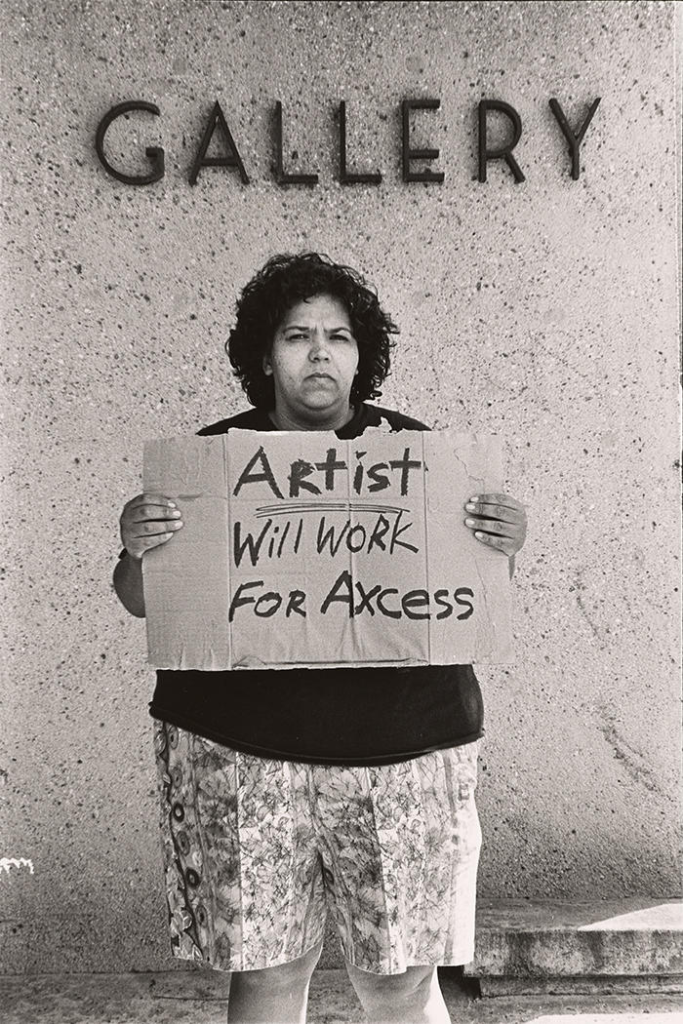
In thinking about who has the privilege of accessing art and images, we collaborated with Conor Moynihan, Assistant Curator of Prints, Drawings, and Photographs at the RISD Museum, to embark on a month-long project that involved writing alternative text descriptions for artwork for his upcoming show, Variance: Making, Unmaking, and Remaking Disability.
Alternative text, commonly known as alt text, refers to brief textual descriptions that are embedded in image files on digital platforms. Alt text makes visual images accessible and can be enjoyed by anyone who use screen readers, or software applications that can read text aloud on websites.
The project taught us about a type of art writing that is often overlooked yet incredibly important as we are thinking about expanding access to art and art institutions. Writing alt text allowed us the opportunity to slow down and think carefully about the language we use to describe images, including the sometimes exclusionary and sight-privileging words we are used to using everyday.
Alt text is also often written collaboratively, which allowed us to think through the process of collaborating in writing. Each of us wrote alt text descriptions on our own, and then we paired together to create final drafts for each image. It was particularly interesting to see where each description diverged, and working together allowed for the alt text descriptions to be even richer as we talked through the precise language that was being used.
To read more about the project, Community-Based Learning and Research fellow Grace Xiao wrote an article for the RISD Museum website discussing the process of writing and editing alt text, along with some thoughts on the power of text and language in museums more generally. The article can be found here.
Here are some resources that Conor gathered to learn more about writing alt text:
Cooper Hewitt Guidelines for Image Descriptions
Accessibility in the Arts: A Promise and a Practice
“How to Write Alt Text and Image Descriptions for the visually impaired”
“Verbal Description Training: Developing Skills of Describing Visual Images and Objects UsingNon-visual Language”
“Using a Screen Reader”
“How Museums are Making Artworks Accessible to Blind People Online”
Alt Text as Poetry
Note from Grace: I personally enjoy going through the Alt Text as Poetry project, which was designed by Bojana Coklyat and Shannon Finnegan. While there are many models for “academic writing,” I think it is important to establish models for writing alt text as well. I find it helpful to look through people’s image descriptions on social media to see how they approach this as well. Some personal favorites include queer Filipinx disabled transgender writer Kay Ulanday Barret (@brownroundboi) and queer disabled artist Shannon Finnegan (@shanfinnegan).
